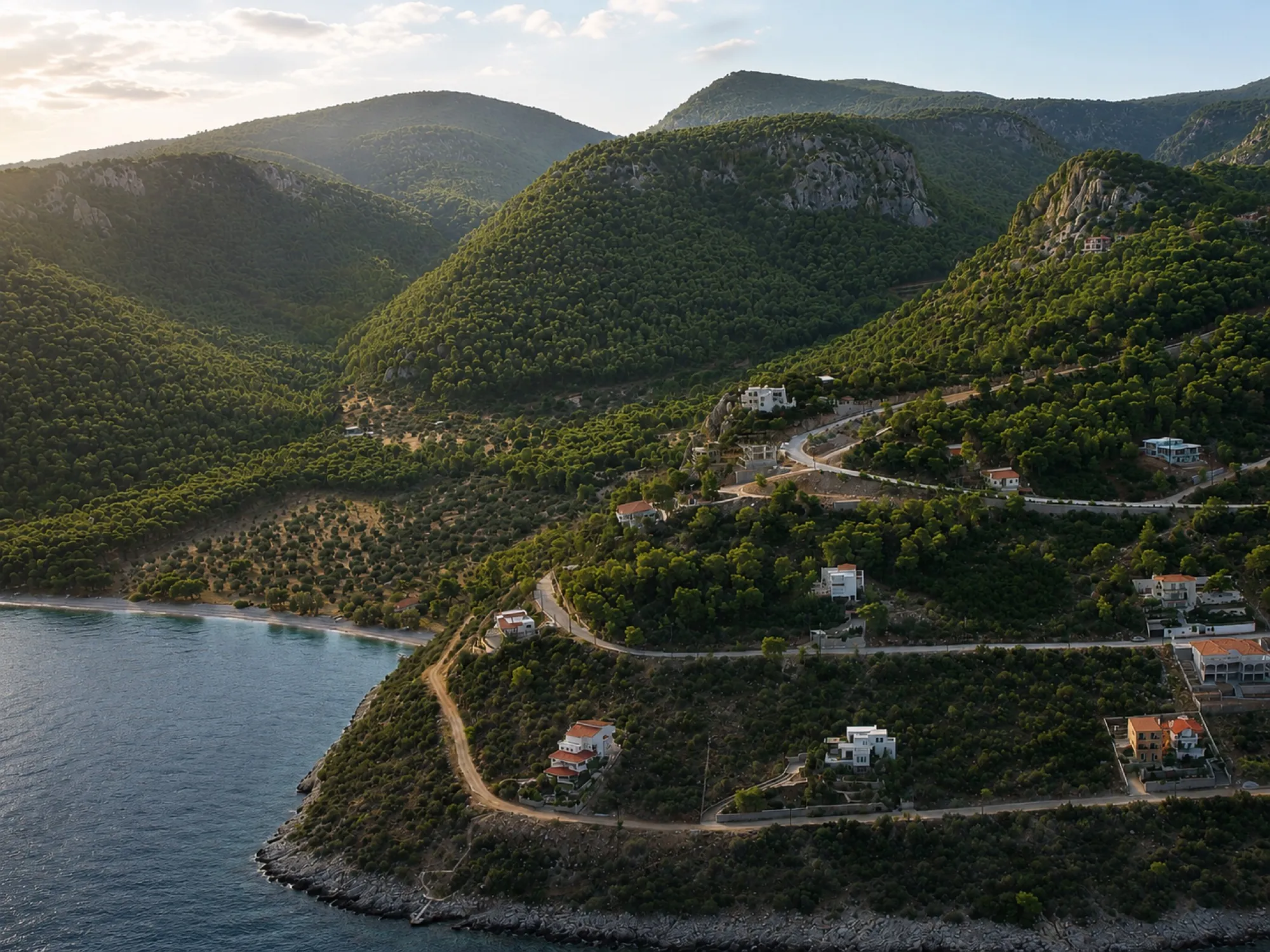
Why invest in Greek coastal land now
A rising market, strong tourism, and a residency pathway available to buyers who build, set against one of Europe's most enduring lifestyle destinations.
A market with genuine momentum
Greek residential property has now risen for 27 consecutive quarters, sits above its 2008 peak, and is roughly 86% above its 2017 trough. Prices rose a further ~7.7% in 2025 (Bank of Greece / ELSTAT data), with a more moderate 4–7% forecast for 2026.
This trajectory describes Greece's built residential market: the value chain that a completed home on land like this ultimately enters. Bare land is the entry point into that chain: a buyer who develops the site captures both the construction margin and the region's ongoing appreciation, rather than paying a premium for a finished structure someone else built.
Tourism receipts reached roughly €20.5bn in 2023 and have continued to rise, underpinning demand for Greek property broadly; Greek GDP growth (~2.1–2.3%) has also run above the eurozone average in recent years.
The Golden Visa: a pathway
Buying this land does not, on its own, grant a Golden Visa. But building a qualifying home on it can open that pathway.
How the tiers work
Under Law 5100/2024 (effective 31 August 2024), the investment threshold is €800,000 in Attica/Athens, Thessaloniki, Mykonos, Santorini and the larger islands, and €400,000 everywhere else, including Corinthia and the rest of the Peloponnese. A €250,000 tier applies separately to commercial‑to‑residential conversions and heritage restorations anywhere in Greece.
What qualifies
The €400k/€800k routes require a single residential property of at least 120 m². Because Corinthia sits in the €400,000 tier, a buyer who develops a qualifying home of that size or larger on this land can pursue the Golden Visa through the completed residence, not through the land purchase itself.
What you get
A five‑year, renewable residence permit with no minimum stay requirement, covering spouse, children under 21 and both spouses' parents, Schengen travel, and a path to citizenship after seven years of lawful residency (conditions apply). Note that short‑term, Airbnb‑style letting is banned on qualifying properties.
This is a general summary, current as of 2026, and not immigration or legal advice. Golden Visa rules, thresholds and property requirements can change; always confirm current requirements with a licensed Golden Visa specialist or immigration lawyer before relying on this pathway.
Why coastal Peloponnese land
Priced below the capital
Market analysts have flagged Peloponnese coastal land as a beneficiary of the Golden Visa's higher Attica/island thresholds: buyers priced out of the €800,000 tier are increasingly looking at secondary coastal markets like Corinthia, supporting demand and appreciation runway.
Foreign investment is active
Foreign real‑estate investment in Greece remains strong, with the Golden Visa programme alone drawing a record ~€2.32bn in 2024, a sign of sustained international appetite for Greek property.
Tax & lifestyle
Property transfer tax runs around 3.09%. Beyond the numbers, Corinthia offers a genuine Mediterranean lifestyle of sea, wine country and ancient history, within a single drive of Athens, rather than a multi‑hour island crossing.
What the built market looks like today
For context on where Greek residential real estate sits nationally: these figures describe existing, built homes, not this land itself.